
The System Is Rigged Against You Welcome to the “Silent Struggle.” If you are reading this, you don’t need a “savings plan”, you need a Bad Debt Exit Strategy. It starts with a notification on your phone.It’s the 25th of the month. “Gaji Masuk.” For a fleeting moment, maybe 30 seconds, you feel a sense […]
Welcome to the “Silent Struggle.” If you are reading this, you don’t need a “savings plan”, you need a Bad Debt Exit Strategy.
It starts with a notification on your phone.
It’s the 25th of the month. “Gaji Masuk.”
For a fleeting moment, maybe 30 seconds, you feel a sense of relief. You see the numbers in your Maybank or CIMB account swell up. You take a deep breath. You think, “Okay, this month will be different. This month, I’m going to save. This month, I’m finally going to get ahead.”
Then, the second wave of notifications begins.
Within 24 hours, that sense of relief is replaced by that familiar, sinking feeling in the pit of your stomach. The numbers in your account have evaporated. You haven’t even bought groceries yet. You haven’t paid for petrol to get to work next week. You haven’t set aside money for your child’s school fees.
Just like that, you are back to zero. Or worse, you are in the negative.
So, what do you do? You do what millions of Malaysians are forced to do. You reach for the “Plastic Saviour.” You swipe the credit card to pay for petrol. You use “PayLater” apps. You take a small cash advance just to survive until the next 25th. And the cycle repeats.
I want you to know something the banks won’t: It is not your fault. You aren’t “bad with money.” You are a victim of a financial system optimized to keep you in debt. You’re playing a rigged game, and the only way to win is to deploy a Bad Debt Exit Strategy immediately.
Let’s look at the script you followed. It’s the same script our parents taught us, the same script society drilled into our heads since primary school.
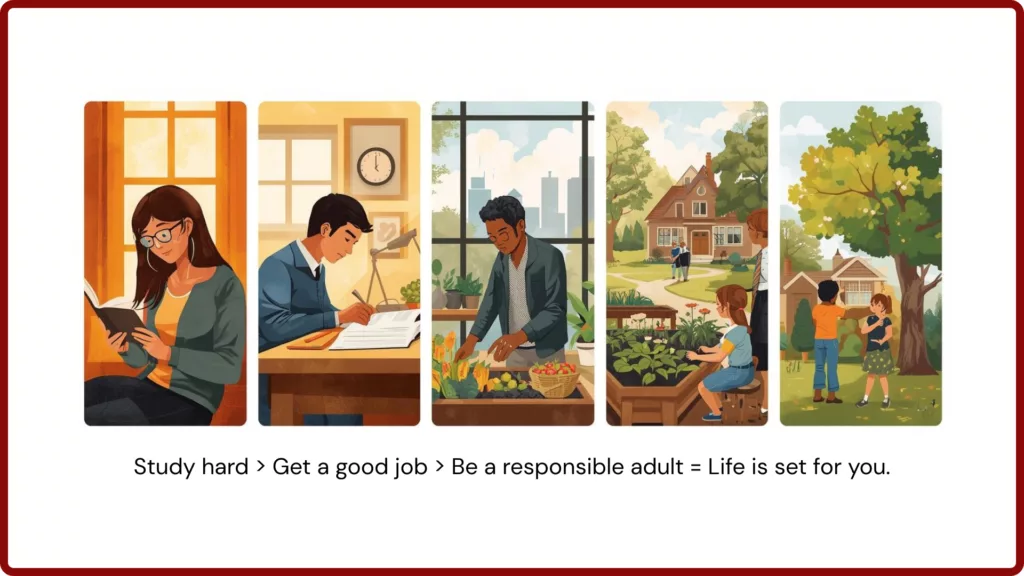
You did everything “right.” You were a good citizen. You contributed to the economy. But look at where that got you.
You are working 9 to 6 (or 9 to 9). You are tired. You miss time with your family. And yet, at the end of the month, you have nothing to show for it except a stack of bills and a rising blood pressure reading.
You look at Instagram and see your friends going on holiday to Japan, buying new cars, eating Omakase. You wonder, “What is wrong with me? Why am I the only one drowning?”
I’ll tell you a secret: They are drowning too.
They are just hiding it better. In Malaysia, “Face” is everything. We finance our lifestyles to look successful, while privately we are taking anxiety medication because we don’t know how to pay for next month’s car installment.
When you finally work up the courage to Google “How to get out of debt,” what do you find? You find the “Guru Advice.”
Let’s be brutally honest for a second. Do you really think cancelling your RM40 Netflix subscription is going to fix a RM50,000 hole in your finances?
Do you really think skipping your morning Teh Tarik is going to stop the bank from charging you 18% interest on your RM15,000 credit card balance?
This advice is insulting. It treats a gunshot wound with a plaster. Your problem isn’t the coffee; it’s that your debt structure is cancerous. You are fighting a mathematical war. This is where a Bad Debt Exit Strategy becomes your most powerful weapon.
If you have a RM10,000 credit card balance at 18% and pay the minimum, it takes 7+ years to clear. And in that time, you will pay the bank thousands of Ringgit in interest alone. You are literally working months of your life just to feed the bank’s profit margin.
Now imagine you have three credit cards, a personal loan, and a car loan. You are paying 15%, 18%, maybe even 24% effective interest rates. Meanwhile, your salary grows by maybe 3% a year (if you’re lucky). Do the math. 18% vs 3%.
You need to stop running on the treadmill and start a Bad Debt Exit Strategy that focuses on interest arbitrage.
If “saving” doesn’t work, and “working harder” isn’t enough, what is the solution?
You need to stop thinking like a “Consumer” and start thinking like a “CFO” (Chief Financial Officer). When a large corporation like Malaysia Airlines or Proton gets into debt trouble, do they start cutting the coffee budget in the office pantry?
No. They Restructure. They look at their “Toxic Debt” (high interest) and they swap it for “Good Debt” (low interest). They negotiate. They consolidate. They change the terms of the game. They use a Bad Debt Exit Strategy to swap “Toxic Debt” (18%) for “Green Zone Debt” (3-4%).
I will not tell you to eat Maggi Mee for the next 5 years. I will not tell you to sell your car and take the bus. I am going to show you the “Bad Debt Exit Strategy.”
This is a specific, tactical protocol derived from Strategy 4 of our financial ebook. It is the method of taking all your “Red Zone” debts (Credit Cards at 18%, Personal Loans at High Rates) and consolidating them into a single “Green Zone” facility at 3-4%.
We are going to use the banks’ own rules against them. We are going to show you how to:
You are about to learn the difference between “paying off debt” (the hard way) and “restructuring debt” (the smart way). The Snowball Method is fine if you have extra cash. But if you are drowning, you don’t need a snowball. You need a life raft.
For second-time homebuyers, this Bad Debt Exit Strategy is the only way to repair your DSR (Debt Service Ratio) so you can actually get your next property loan approved. You can check more about legal debt rights at AKPK, but for structured investment growth, you need our specific FAR protocol.
The bank’s worst nightmare is a customer with a Bad Debt Exit Strategy. They want you to stay in the “Grey Zone”, not bankrupt, but never debt-free. They want you to be a permanent subscriber to their interest.
It stops today. By executing a Bad Debt Exit Strategy, you are declaring war on the status quo. You are choosing to protect your family’s future over the bank’s profit margin.
This Bad Debt Exit Strategy isn’t just about numbers; it’s about breathing again. It’s about sleeping at night knowing you aren’t one “emergency” away from disaster.
If you’re an aspiring investor, your journey doesn’t start with buying a house; it starts with this Bad Debt Exit Strategy. Take a deep breath. Forgive yourself for the past. It’s time to declare war on your debt. Turn the page. Let’s get to work.

