Bad Debt Vs Good Debt: Why A New Car Is The Worst Thing You Do?
You have spent years studying, working late nights, and climbing the corporate ladder. Now, you finally have the corporate salary to show for it. Your bank account looks healthier than ever, and that old college sedan is starting to feel out of place in the office parking lot. You feel you deserve a reward. You […]
Hajar Abdullah
June 15th, 2026
No Comments
Table Of Contents
You have spent years studying, working late nights, and climbing the corporate ladder. Now, you finally have the corporate salary to show for it. Your bank account looks healthier than ever, and that old college sedan is starting to feel out of place in the office parking lot. You feel you deserve a reward.
You want something shiny, reliable, and modern to signal that you have arrived. The temptation to walk into a dealership and sign a lease or loan for a brand-new premium vehicle is incredibly high. Society tells you this is the logical next step for a successful working professional.
However, buying a brand-new car on finance is often the single most destructive financial move a young professional can make. It is a decision that sets your wealth-building timeline back by years, if not a whole decade.
When you are in the awareness stage of your financial journey, you begin to see that true wealth is not about what you display to the world. It is about what you own that works for you while you sleep. A new car does the exact opposite. It works against you every single second of the day.
The Brutal Physics of Car Depreciation
Let us look at the cold, hard numbers behind automotive ownership. A vehicle is an operational tool, not an investment. The moment you drive a new car off the dealership forecourt, its market value drops by roughly 15% to 20%.
[ New Car Purchase ] ---> Drops 20% Value Instantly ---> Value Melts Every Year
Imagine walking to a river and throwing a large stack of hundred-dollar bills directly into the water. That is the physical reality of driving a brand-new vehicle home. By the end of the first twelve months, that vehicle has shed a massive chunk of its initial worth. By year five, most vehicles are worth less than half of what you originally paid.
Yet, if you financed that vehicle, your loan balance does not decrease in tandem with that drop in value. You are still paying interest on the full initial amount you borrowed. You are effectively trapped inside a melting ice cube, paying premium rates for a asset that loses value daily.
For a working professional, time is your greatest asset. When you deploy your capital into a rapidly depreciating machine, you lock up cash flow that could have been used to secure your financial freedom.
The Core Financial Battle: Bad Debt vs Good Debt
To understand why this choice is so damaging, we must break down how different types of liabilities operate. Not all loans are created equal, and understanding this distinction is what separates the struggling middle class from the truly wealthy.
Many people are taught that all borrowing is inherently dangerous. This is a massive misconception that keeps people trapped in the corporate rat race. The truth is that leverage is the primary mechanism used by high-net-worth individuals to scale their portfolios. The secret lies in distinguishing between the forces that build your net worth and those that destroy it.
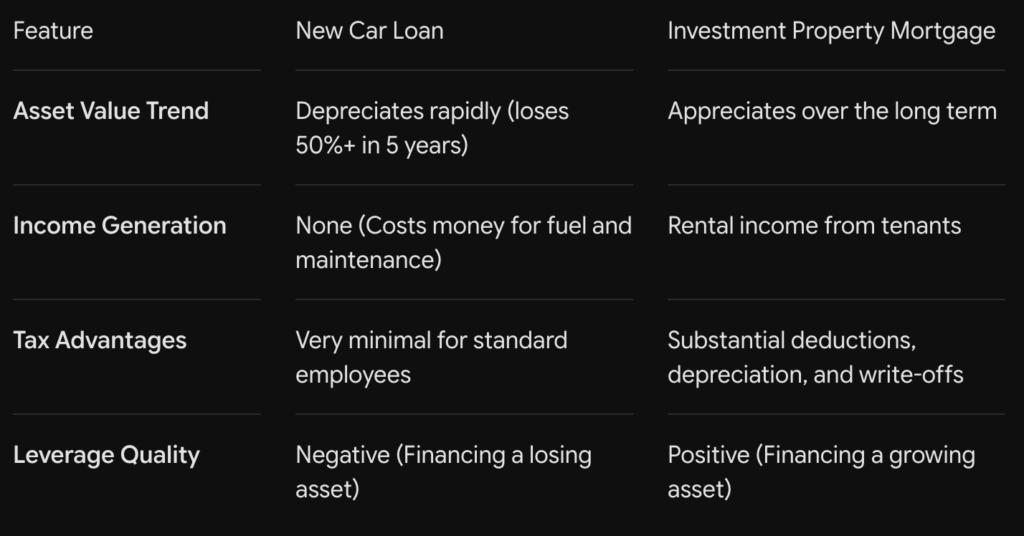
When you borrow money to purchase an item that drops in value and produces absolutely no income, you are engaging with a destructive force. This type of borrowing requires you to use your active salary to pay off a diminishing asset, leaving you poorer over time.
Conversely, when you utilize financing to acquire a high-quality, appreciating asset that generates regular income, you are using leverage to accelerate your wealth. The tenants essentially pay down your obligation while the underlying asset grows in value, creating a self-sustaining wealth machine.
Expert Insight: Wealthy individuals use leverage to acquire income-producing assets. True financial freedom is achieved when your investments generate enough cash flow to pay for your luxury items naturally.
The Direct Clash: Car Loans vs. Mortgages
Let us contrast the structure of a standard vehicle loan against a property mortgage. When you obtain a vehicle loan, you are borrowing money for a short duration, usually three to seven years, at a relatively high interest rate. The monthly payments are substantial because you are forcing the repayment of the principal asset over a very compressed timeline.
A mortgage on a residential property operates on an entirely different economic model. It is typically spread across twenty-five to thirty years, which keeps your mandatory monthly outgoings manageable relative to the total value of the asset.
More importantly, real estate has a historic tendency to appreciate over the long term due to land scarcity and population growth.
When you put your money into property, you can utilize the concept of positive gearing or neutral gearing, where your rental income covers a large portion or all of your mortgage obligations. Try asking a car dealership if your new sedan can generate monthly rental income that covers its own loan payment while increasing in value. The answer is an obvious no.
The Hidden Portfolio Killer: Borrowing Capacity
This is the exact section where most young professionals make a catastrophic mistake without realizing it. They look at a vehicle payment and think, “I earn RM4,000 a month, so I can easily afford a RM600 monthly payment.”
What they fail to realize is how a bank calculates your debt servicing ratios when you apply for a home loan later on.
Banks do not look at a car loan as a minor expense. When a credit analyst reviews your mortgage application, they use strict formulas to determine your Debt Service Ratio (DSR). A fixed, non-negotiable monthly liability like a vehicle loan heavily damages your borrowing capacity.
For every dollar you owe on a vehicle loan, a bank will slash your potential mortgage borrowing capacity by a factor of four to five. That seemingly innocent RM600 monthly vehicle payment could literally wipe out RM100,000 of borrowing power when you attempt to purchase your first investment property.
[ RM600/Month Car Loan ] === Blocks ===> [ ~RM100,000+ Property Borrowing Power ]
Imagine finding the perfect investment property, a duplex in a growing suburb that promises great rental yields and excellent capital growth. You submit your paperwork to the bank, only to be rejected because your luxury vehicle loan consumes too much of your discretionary income.
You are forced to watch that property opportunity vanish, all so you could drive a shiny vehicle to your office cubicle.
Your Tactical Roadmap Out of the Consumer Trap
If you want to achieve true financial independence and build a highly profitable real estate portfolio, you must learn to delay gratification early in your professional career. Here is the step-by-step framework you should follow:
First, change your perspective on what a vehicle represents. A vehicle is a utility designed to safely transport you from point A to point B. It is not an extension of your self-worth or a metric of your professional success.
Second, buy a reliable used vehicle from a trusted manufacturer. Look for a vehicle that has already taken the massive initial hit of depreciation. A three-to-four-year-old vehicle often looks and drives like new, but costs a fraction of its original price.
Third, preserve your clean credit profile. Avoid any form of consumer financing, personal loans, or lifestyle credit cards. Keep your debt-to-income profile pristine so that when you approach a prime mortgage lender, you look like an incredibly safe, low-risk borrower.
Finally, take every single dollar of excess cash flow from your corporate salary and route it into a dedicated property investment fund. Study the local real estate markets, learn how to analyze rental yields, and prepare yourself to buy your first appreciating asset.
Once your property portfolio grows and your investment assets start generating massive passive cash flow, you can use that extra rental income to buy whatever luxury car you want. But until then, keep your head down, guard your borrowing capacity, and avoid the trap of the brand-new car loan at all costs. Your future self will look back and thank you for your financial discipline.