
Check Home Loan Eligibility Malaysia

Don't get rejected. Calculate your Debt Service Ratio (DSR) and find your maximum loan eligibility in 30 seconds.
DSR Calculator

Loan Eligibility Calculator

Cars, PTPTN, Credit Cards, Personal Loans

Your Results

Great! Based on the DSR score calculated above, you are likely to be approved.
Borderline. Based on the DSR score calculated above you may need more documentation.
High Risk. Based on the DSR score calculated above you are likely to be rejected.

Book a Free Consultation to Fix This

What Is Loan Eligibility?

In Malaysia, loan eligibility is a measure used by banks and financial institutions to determine whether you qualify for a loan. It refers to the specific criteria, such as age, income, employment status, credit score, and existing debt, used to assess a borrower’s ability to repay the loan. It determines the maximum amount, interest rate, and tenure offered when you qualify for a loan. 
Key factors determining eligibility include:
  • Income and Employment
  • Credit Score from CTOS or CCRIS
  • Debt Service Ratio (DSR)
  • Age 21-60 years old
Tip: "Eligibility" is not the same as "affordability." A bank might say you are eligible for a RM500,000 loan, but after accounting for your lifestyle and family expenses, you might only afford an RM350,000 loan.

What Is LTV?

In the context of Malaysian banking, LTV stands for Loan-to-Value ratio.

Simply put, it is the percentage of a property's value that a bank is willing to lend you. The remaining percentage is your downpayment. It is the bank's way of limiting their risk; if you can't pay back the loan, they want to ensure the property is worth more than the debt.
Standard LTV Caps in Malaysia
Bank Negara Malaysia (BNM) sets specific limits on LTV ratios to prevent the property market from overheating.
Property Count
Housing Loan LTV Cap
Typical Downpayment
1st Home
Up to 100%
0 - 10%
2nd Home
Up to 90%
10%
3rd Home onwards
70%
30%

What is DSR and How Does It Affect My Loan?

The Debt Service Ratio (DSR) is the calculation banks use to check if you can afford the loan repayment. It is calculated as:

DSR = (Total Monthly Commitments + New Loan Installment) ÷ Net Income × 100

Banks in Malaysia typically set a maximum DSR threshold between 60% to 70%. If your DSR exceeds this, your loan application will likely be rejected.

DSR Danger Zones

Below 60%

Healthy — Banks will approve easily

60% – 70%

Caution — Depends on bank & profile

Above 70%

Danger — Most banks will reject
Safe
Caution
Danger

Why Loans Get Rejected (And How to Fix It)

The three most common reasons Malaysian home loan applications fail.
CCRIS: Bad Paymaster Record
Problem
Your CCRIS report shows late or missed payments, flagging you as a risky borrower.
Solution
Clear all arrears immediately. Maintain a clean record for 12 months before re-applying.
CTOS: Legal Action / Trade Reference
Problem
Outstanding legal cases or negative trade references appear in your CTOS report.
Solution
Clear all arrears immediately. Maintain a clean record for 12 months before re-applying.
Income: Variable or Insufficient
Problem
Irregular income (freelance, commission-based) makes it hard for banks to assess affordability.
Solution
Provide 6 months' bank statements, EA Form, and latest tax return (BE Form) to prove stable income.

Housing Loan Eligibility Calculator for Government (LPPSA)

Government servants (Penjawat Awam) are eligible for 100% financing via LPPSA (Lembaga Pembiayaan Perumahan Sektor Awam).

Your eligibility is based on the Net Disposable Income (NDI) rule, not the standard DSR used by commercial banks. This typically allows government servants to borrow more.

The NDI is calculated after deducting all statutory deductions (EPF, SOCSO, tax) and existing commitments from your gross salary.

Common Questions on Eligibility

  • Citizenship: Open to Malaysians and foreigners.
  • Age: Minimum 21 years old. The maximum age is typically 70 years old by the end of the loan tenure.
  • Employment: Salaried. Usually requires at least 3–6 months with the current employer.
  • Self-Employed: Requires a registered business (SSM) active for at least 2 years.

Approximately RM4,000 – RM4,500 net household income, assuming no other major debts and a 35-year tenure at ~4.2% interest rate. If you have existing commitments (car loan, PTPTN), you'll need higher income.
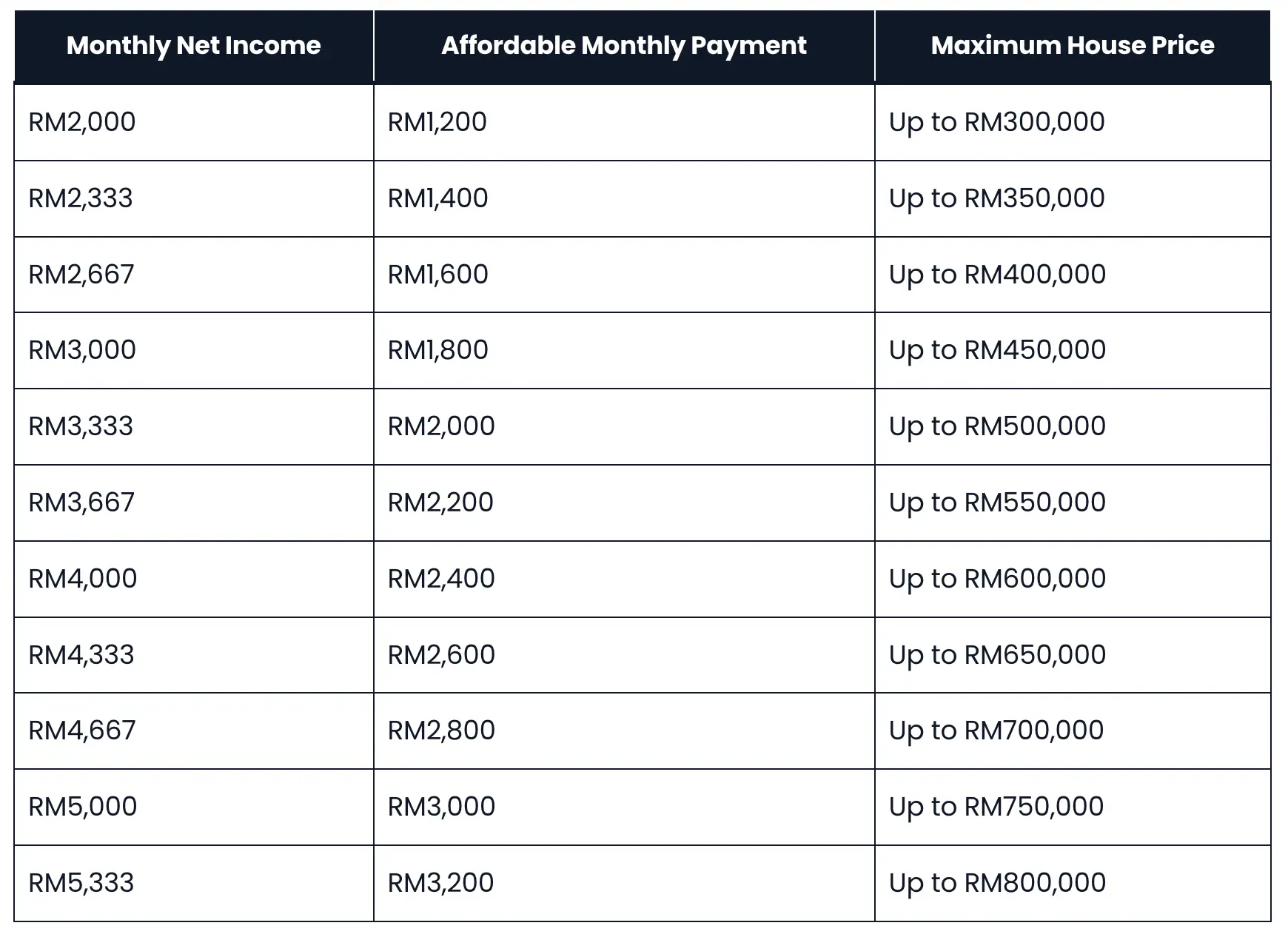
loan eligibility

Yes, joint loans are the best way to increase eligibility and lower your DSR. Both applicants' incomes are combined, and both share the debt obligation. This is the most common strategy for first-time buyers.

Yes, PTPTN is counted as a commitment in your CCRIS report. You must be paying it regularly — any arrears will hurt your credit score. The monthly instalment is included in your DSR calculation.

Below 60% is considered healthy by most banks. Some premium banks accept up to 70%, but anything above that will almost certainly be rejected. Aim to keep your DSR as low as possible.

Typically 1–2 weeks for conditional approval from the bank, and another 2–4 weeks for the full loan offer letter. Government loans via LPPSA may take longer depending on documentation.

Age Limit for 21 to 65 - 70 years

As a general rule for 2026, most banks require a minimum individual gross income of RM2,000 to RM3,000 to even start the conversation for the most basic properties.

To calculate home loan eligibility, Malaysian banks use a combination of mathematical formulas and risk assessments. While every bank has its own "secret sauce," they all follow a standardized framework.
  • Debt Service Ratio (DSR)
  • Net Disposable Income (NDI)
  • Stress Test Interest Rate
  • Credit Scoring (CCRIS & CTOS)

Each bank operates with a different "risk appetite" and uses different methods to calculate net income. For example, some banks recognize 100% of rental income, while others only recognize 70%. Some banks use gross income to calculate DSR, while most local banks use net income (after EPF/Tax). This variation means that an applicant may be rejected by one bank but approved by another for the same property.

Ironically, having no debt can sometimes be as bad as having bad debt. If you've never had a credit card or a loan, the bank has no data to prove you are a "good paymaster." If you plan to buy a home in 6–12 months, apply for a credit card now. Use it for small petrol or grocery bills and pay it off in full every month to build a "green" CCRIS record.

This is a common frustration. Rejection usually happens for one of three "hidden" reasons:
  • Too Many Applications: Applying to 5 banks at the same time can trigger a red flag, making you look like you're in a financial crisis.
  • The Property Itself: The bank might not like the property (e.g., a developer with a bad track record, or a leasehold property with very few years left).
  • Low NDI: Even with a RM10,000 salary, if your lifestyle expenses and other debts leave you with only RM500 at the end of the month, the bank will reject you for your own safety.

In 2026, banks are much more open to the "Gig Economy" than they used to be.
  • The Requirement: You typically need 2 years of income proof.
  • Key Tip: Look into the SJKP (Housing Credit Guarantee Scheme). The government acts as your "guarantor," making it much easier for those without a standard monthly payslip to get a 100% loan.
evergreen LP - buy property in malaysia 2025
Choose 1, more or all webinar you want to join:
Arbitrage Advantage past webinar recording form
Crisis 2025 past webinar recording form
Property Filter past webinar recording form
BR past webinar recording form
DOG past webinar recording form