
One of the most common financial dilemmas faced by individuals and families is deciding whether to rent or buy a home. It’s a massive financial crossroads that can either set you up for life or leave your bank account feeling a bit light. Basically, in Malaysia, this decision has become increasingly important due to rising […]
One of the most common financial dilemmas faced by individuals and families is deciding whether to rent or buy a home. It’s a massive financial crossroads that can either set you up for life or leave your bank account feeling a bit light.
Basically, in Malaysia, this decision has become increasingly important due to rising property prices, changing rental markets, and evolving lifestyle needs.
Many people assume that buying is always better because it builds ownership, while renting is often perceived as “money wasted.” However, the reality is more nuanced.
Is renting truly “throwing money away”? Or is buying at today’s prices a risky gamble? In this guide, we’re breaking down the legendary 50/50 Rule to help you decide once and for all: should you rent or buy?
We want asset ownership, but we don’t want to be “house poor.” Thus, this is a practical framework used by many property investors and homeowners – the 50% Rule.
It helps determine whether renting or buying makes more financial sense based on the relationship between monthly rental rates and mortgage instalments.
Instead of relying solely on emotions or “what your family or parents said,” this rule introduces a simple mathematical approach to evaluate housing decisions. By comparing the cost of renting with the cost of owning the same property, you can finally understand if you’re paying too much rent or if purchasing would create a long-term goldmine.
The 50/50 Rule (sometimes simplified as the 50% Rule) is the ultimate “BS detector” for the property market. It’s a benchmark that compares your potential monthly rent to what your mortgage installment would be for the exact same unit.
When you rent or buy, you are essentially choosing how to pay for “shelter.”
The 50/50 Rule acts as the bridge between these two worlds, telling you when the “cost of flexibility” (rent) becomes too expensive compared to the “cost of ownership” (mortgage).

The 50/50 Rule proposes a very specific hypothesis when you are torn between whether to rent or buy:
The Rule: If the monthly rental of a property exceeds 50% of the monthly mortgage installment, it is generally more beneficial to buy the property instead of renting.
Conversely, if the monthly rent is less than 50% of the mortgage installment, it may be more financially practical to continue renting and invest your surplus cash elsewhere (like a diversified portfolio).
The logic behind this rule is based on opportunity cost. When rent approaches the cost of a mortgage payment, you are effectively paying a large amount of money without gaining ownership of an asset. In contrast, purchasing the property converts those monthly payments into equity.
Think of it this way: a portion of your mortgage goes to interest (bank profit), but the rest goes to the principal (your future wealth). If your rent is already covering more than half the mortgage, you’re basically paying the landlord’s interest and a bit of their principal. Ouch!
Let’s get into some real numbers. When applied to real property scenarios in cities like KL, Penang, or JB, the 50/50 rule reveals some shocking truths.
Imagine a stylish condo in Cheras or Petaling Jaya.
Scenario A: The Renting Win
If the rental rate for this unit is RM700, you are only paying 35% of the mortgage value. In this case, renting is a financial masterstroke. You save RM1,300 a month compared to a buyer, which you can pump into your EPF or stocks.
Scenario B: The Buying Trigger
If the rent rises to RM1,400 or RM1,500, you are now paying 70–75% of the mortgage cost. Now, the rent or buy debate swings heavily toward buying. Why?
Because the monthly payment is already so close to what a homeowner would pay the bank. You’re doing the heavy lifting for the landlord; you might as well be the landlord yourself!
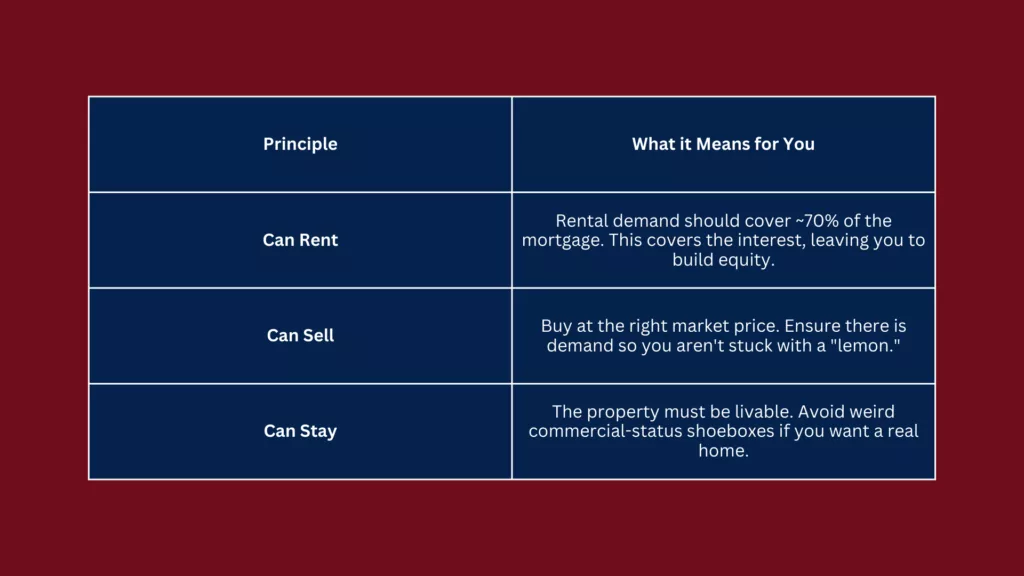
This situation also supports a widely used property principle among investors: Can Sell, Can Rent and Can Stay.
1. Can Rent
Ideally, rental demand should cover at least 70% of the mortgage installment, which often corresponds to the interest portion of the loan. The remaining payment contributes to the principal, effectively building the homeowner’s equity.
2. Can Sell
The property must be purchased at the right market price, ensuring there is sufficient demand and liquidity if the owner decides to sell in the future.
3. Can Stay
Regardless of its investment potential, the property must be suitable for living. For example, a residential property in a livable environment is generally more practical for own-stay purposes than a property with commercial status.
When these three criteria are fulfilled, the decision to purchase a property for personal residence becomes financially and practically sound.
The decision to rent or buy a home should not be based solely on social pressure or the fear of missing out (FOMO). Instead, applying financial guidelines such as the 50% Rule provides a more rational framework for evaluating property choices.
Summary Checklist:
If rental costs exceed half of the mortgage installment, purchasing the property may offer better long-term financial benefits. On the flip side, when rental rates are dirt cheap compared to mortgages, renting allows you to stay flexible and keep your capital for other opportunities.
Ultimately, the best decision depends on your financial capability and market conditions. By combining the 50/50 rule with a structured learning approach, you can stop wondering and start building your Malaysian dream.

